Magnetic Hysteresis
Most of the magnetic properties of materials of practical concern in MPI are defined by the magnetic hysteresis loop or B&H curve.
When an un-magnetised piece of ferromagnetic material is exposed to a gradually increasing positive magnetic force and the strength of the induced flux density (B) is plotted against the magnetising force (H), a B&H curve is produced. If the plot continues in the opposite direction a hysteresis loop evolves.
Barkhausen Noise is described as jumps in permeability on the hysteresis loop where grain boundaries growth and/or dislocations, interfere with the grown of the domains.
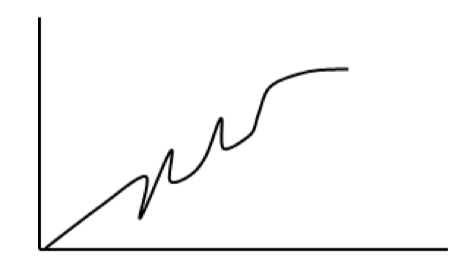
This is becoming an area of interest for determining properties of materials, particularly if they are subjected to heat treatment.
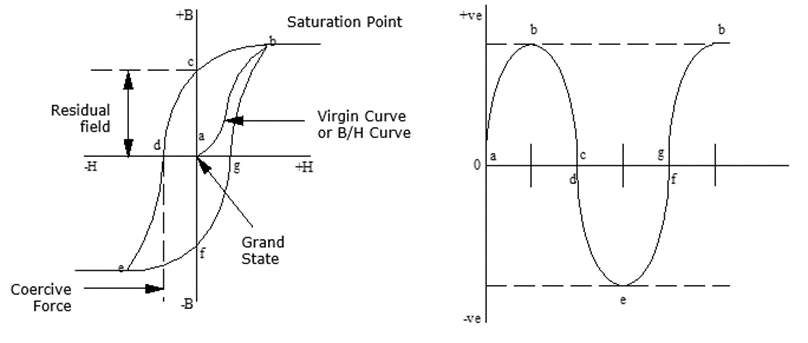
As the magnetising force (H) is increased, the induced magnetic field (B) also increases until it reaches its saturation point (b). At this point the material is said to be magnetically saturated, this is the point when the maximum flux density has been reached.
When the magnetic force (H) is reduced, the flux density (B) also reduces but falls behind (lagging) the original curve so that when H is back to zero there is still some magnetic flux in the material (c). This is a measure of the material’s retentivity.
If the polarity of the magnetising force is now reversed, B will return to zero (d). This point represents the coercive force required to remove the residual magnetism from the material.
By continuing all the previous actions in the opposite direction, a complete loop will be formed.
When AC is used for magnetising a specimen, a complete hysteresis loop is produced with each cycle of current; in the U.K. this is 50 times per second. (50 cycles per second = 50 Hz (Hertz)).
A material which exhibits a hysteresis loop with a wide appearance will have high retentivity and therefore may be useful for making permanent magnets (e.g. high carbon steel). A material which exhibits a hysteresis loop with a narrow appearance will have low retentivity and therefore may be useful for making magnetic particles (e.g. low carbon steel).
The gradient of the loop also gives information regarding the usefulness of materials for use in magnetising apparatus, for making magnetic particles or for magnetising purposes. For example, a material which exhibits a steep gradient will attain a high flux density when using a low magnetising force.